A mega shark that lived 300 million years ago would have made today's great whites look like shrimps, according to fossils of thebeast unearthed in Jacksboro, Texas.Scientists have dubbed the newfound fossils the "Texas supershark,"and the name is fitting: These supersharks were enormous: more than 26 feet (8 meters) long, or more than half the length of aschool bus. That's 25 percent larger than the modern great white shark and more than three times as long as other fossil sharks, including the Goodrichthys eskdalensis shark discovered in Scotland and another newfound shark specimen from New Mexico, both ofwhich measure between 6.5 feet and 8.2 feet (2 m and 2.5 m)from head to tail. (Earth's largest shark, C. megalodon, could grow up to 60 feet, or 18 m, long during its heyday, between about16 million and 2.6 million years ago.)
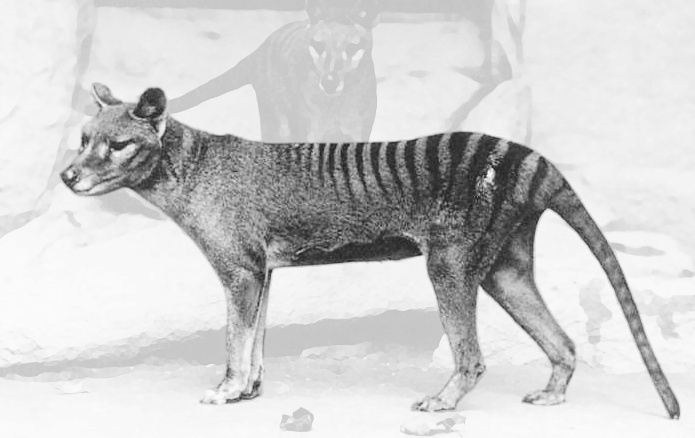
The thylacine had become extremely rare or extinct on theAustralian mainlandbeforeBritish settlementof the continent, but it survived on the island ofTasmaniaalong with several otherendemicspecies, including theTasmanian devil. Intensive hunting encouraged bybountiesis generally blamed for its extinction, but other contributing factors may have been disease, the introduction of dogs, and human encroachment into its habitat. Despite its official classification as extinct, sightings are still reported, though none has been conclusively proven.
Long and slender, the blue whale's body can be various shades of bluish-grey dorsally and somewhat lighter underneath.[13] There are at least three distinct subspecies: B. m. musculus of the North Atlantic and North Pacific, B. m. intermedia of the Southern Ocean and B. m. brevicauda (also known as the pygmy blue whale) found in the Indian Ocean and South Pacific Ocean. B. m. indica, found in the Indian Ocean, may be another subspecies. As with other baleen whales, its diet consists almost exclusively of small crustaceans known as krill.[14]
Blue whales were abundant in nearly all the oceans on Earth until the beginning of the twentieth century. For over a century, they were hunted almost to extinction by whalers until protected by the international community in 1966. A 2002 report estimated there were 5,000 to 12,000 blue whales worldwide,[15] in at least five groups. More recent research into the Pygmy subspecies suggests this may be an overestimate.[16] Before whaling, the largest population was in the Antarctic, numbering approximately 239,000 (range 202,000 to 311,000).[17] There remain only much smaller (around 2,000) concentrations in each of the eastern North Pacific, Antarctic, and Indian Ocean groups. There are two more groups in the North Atlantic, and at least two in the Southern Hemisphere. As of 2014, the Californian blue whale population has rebounded to nearly its pre-hunting population.[
Frogs, Toads, Salamanders and Caecilians That Have Gone Extinct in Modern Times
As a group, amphibians are the most endangered animals on the face of the earth, especially susceptible to human depredation, fungal disease, and loss of their natural habitats. Here are 10 frogs, toads, salamanders and caecilians that have gone extinct in modern times, some as recently as two or three years ago. (See also 100 Recently Extinct Animals and Why Do Animals Go Extinct?)
Recently Extinct Amphibian #1 - The Golden Toad
The Golden Toad (Wikimedia Commons).
Compared to all the other frogs and toads that have gone extinct over the past quarter-century, there's nothing particularly special about the Golden Toad, except for its striking color--and that has been enough to make it the "poster toad" for amphibian extinction. First spotted in a Costa Rica "cloud forest" in 1964, the Golden Toad was only seen intermittently since, and the last documented encounter was in 1989.
The Golden Toad is now presumed to be extinct, doomed by climate change and/or fungal infection.
Recently Extinct Amphibian #2 - The Sri Lanka Shrub Frog
The Sri Lanka Shrub Frog (Flickr).
If you visit Peter Maas' indispensable website The Sixth Extinction, you can see how many frogs of genus Philautus have recently gone extinct, ranging literally from A (Philautus adspersus) to Z (Philautus zimmeri). All of these Philautus species were once native to the island of Sri Lanka, south of India, and all of them were presumably rendered defunct by a combination of urbanization and disease.
As with the Harlequin Toad, below, some species of the Sri Lanka Shrub Frog still persist, but remain at imminent risk.
Recently Extinct Amphibian #3 - The Harlequin Toad
The Harlequin Toad (Wikimedia Commons).
Like many of the amphibians on this list, the Harlequin Toad (also known as the Stubfoot Toad) comprises a bewildering array of species, some of which are thriving, some of which are endangered, and some of which are believed to be extinct. These Central and South American toads are especially susceptible to the killer fungus Batrachochytrium, which has been decimating amphibians worldwide, and Harlequin Toads have also had their habitats destroyed by mining, deforestation and encroachment by human civilization
Recently Extinct Amphibian #4 - The Yunnan Lake Newt
The Yunnan Lake Newt (Wikimedia Commons).
Every now and then, naturalists have the opportunity to witness the slow extinction of a single amphibian species. Such was the case with the Yunnan Lake Newt, Cynops wolfferstorfi, which lived along the rim of Kunming Lake in the Chinese province of Yunnan. This inch-long newt didn't stand a chance against the pressures of Chinese urbanization and industrialization; to quote from the IUCN Red List, it recently succumbed to "general pollution, land reclamation, domestic duck farming and the introduction of exotic fish and frog species."
Not only is Ainsworth's Salamander presumed to be extinct, but this amphibian is known from only two specimens, collected in Mississippi in 1964 and later stored in the Harvard Museum of Comparative Zoology. Since Ainsworth's Salamander lacked lungs, and needed a moist environment in order to absorb oxygen through its skin and mouth, it was especially susceptible to the environmental stresses of human civilization.
(Oddly enough, "lungless salamanders" as a whole are more evolutionary advanced than their lung-equipped cousins!)
Recently Extinct Amphibian #6 - The Indian Caecilian
A typical caecilian (Wikimedia Commons).
The Indian Caecilian, genus name Uraeotyphlus, is doubly unfortunate: not only have various species gone extinct, but most people are only dimly aware (if at all) of the existence of caecilians in general. Often confused with worms and snakes, caecilians are limbless amphibians that spend most of their lives underground, making a detailed census--much less an identification of endangered species--a huge challenge.
Surviving Indian Caecilians, which may yet meet the fate of their extinct relatives, are restricted to the Western Ghats of the Indian state of Kerala.
Recently Extinct Amphibian #7 - The Gastric-Brooding Frog
The Gastric-Brooding Frog (Wikimedia Commons).
Like the Golden Toad, above, the Gastric-Brooding Frog was discovered fairly recently, in 1973--and disappeared off the face of the earth a mere ten years later. This Australian frog was distinguished by its unusual breeding habits: the females swallowed their newly fertilized eggs, and the tadpoles developed in the safety of mom's stomach before climbing out of her esophagus. (In the interim, the female Gastric-Brooding Frog refused to eat, lest her hatchlings be scalded by secretions of stomach acid).
Recently Extinct Amphibian #8 - The Australian Torrent Frog
The Australian Torrent Frog (Wikimedia Commons).
The Australian Torrent Frog, genus Taudactylus, makes its home in the rain forests of eastern Australia--and if you find it difficult to envision an Australian rain forest, you can understand why Taudactylus is in so much trouble. At least two Torrent Frog species,Taudactylus diurnus (aka the Mount Glorious Day Frog) and Taudactylus acutirostris, have gone extinct, and the remaining four are threatened by fungal infection and loss of habitat.
Still, when it comes to endangered amphibians, one should never say die: the inch-long Torrent Frog may yet stage a comeback.
Recently Extinct Amphibian #9 - The Vegas Valley Leopard Frog
The Vegas Valley Leopard Frog (Wikimedia Commons).
The extinction of the Vegas Valley Leopard Frog has a plot twist worthy of a Vegas-themed TV crime drama. The last known specimens of this amphibian were collected in Nevada in the early 1940's, and the lack of sightings ever since led naturalists to declare it extinct. Then, a miracle occurred: scientists analyzing the DNA from preserved Vegas Valley Leopard Frog specimens determined that the genetic material was identical to that of the still-extant Chiricahua Leopard Frog.
Back from the dead, the Vegas Valley Leopard Frog had assumed a new name!
At least the above amphibians on our list had the good fortune to be given memorable names (the Mount Glorious Day Frog, the Harlequin Toad, etc.) No such luck for poorNannophrys guentheri, a Sri Lankan frog of the "ranidae" family that has not been seen in the wild since its type specimens were acquired in 1882. As obscure as it is, though,Nannophrys guentheri is a good stand-in for the thousands of endangered amphibians the world over, which are too dull to be dubbed "golden" but nonetheless are still treasured members of our planet's ecosystem.