Tuesday, 1 December 2015

Is it true?
Is It True.....????
Answers
1.Fearing that the world's most iconic big cat could soon go extinct as humans invade its range, the Obama administration on Monday proposed listing the African lion as a threatened species.
2.Because ivory is so valuable to some humans, many elephants have been killed for their tusks. This trade is illegal today, but it has not been completely eliminated, and some African elephant populations remainendangered.
3.Leopards are graceful and powerful big cats closely related to lions, tigers, and jaguars. They live in sub-Saharan Africa, northeast Africa, Central Asia, India, and China. However, many of their populations areendangered, especially outside of Africa.
4.Emperor penguins should be classed as an endangered species because the majority of colonies will have lost half their populations by the end of the century, biologists have warned. The flightless birds which inhabit Antarctica are threatened by changes to sea ice which are being driving by climate change.
Wednesday, 21 October 2015
Shark Files: Ancient 'Supershark' Unearthed in Texas

A mega shark that lived 300 million years ago would have made today's great whites look like shrimps, according to fossils of the beast unearthed in Jacksboro, Texas.Scientists have dubbed the newfound fossils the "Texas supershark," and the name is fitting: These supersharks were enormous: more than 26 feet (8 meters) long, or more than half the length of a school bus. That's 25 percent larger than the modern great white shark and more than three times as long as other fossil sharks, including the Goodrichthys eskdalensis shark discovered in Scotland and another newfound shark specimen from New Mexico, both of which measure between 6.5 feet and 8.2 feet (2 m and 2.5 m) from head to tail. (Earth's largest shark, C. megalodon, could grow up to 60 feet, or 18 m, long during its heyday, between about 16 million and 2.6 million years ago.)
Wednesday, 14 October 2015
Tasmanian Tiger
The thylacine (/ˈθaɪləsiːn/ thy-lə-seen,[3] or /ˈθaɪləsaɪn/ thy-lə-syn,[4] also /ˈθaɪləsɨn/;[5] binomial name: Thylacinus cynocephalus, Greek for "dog-headed pouched one") was the largest known carnivorous marsupial of modern times. It is commonly known as the Tasmanian tiger (because of its striped lower back) or the Tasmanian wolf.[6] Native to continental Australia, Tasmania and New Guinea, it is believed to have become extinct in the 20th century. It was the last extant member of its family, Thylacinidae; specimens of other members of the family have been found in the fossil record dating back to the late Oligocene.
The thylacine had become extremely rare or extinct on the Australian mainland before British settlement of the continent, but it survived on the island of Tasmania along with several other endemic species, including the Tasmanian devil. Intensive hunting encouraged bybounties is generally blamed for its extinction, but other contributing factors may have been disease, the introduction of dogs, and human encroachment into its habitat. Despite its official classification as extinct, sightings are still reported, though none has been conclusively proven.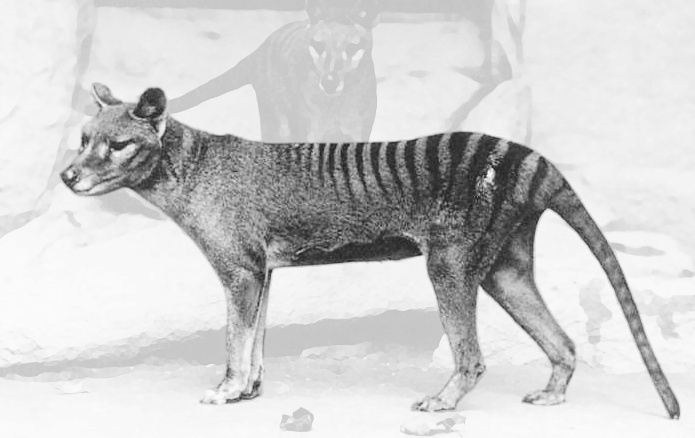
Subscribe to:
Comments (Atom)